Thursday, October 1, 2026

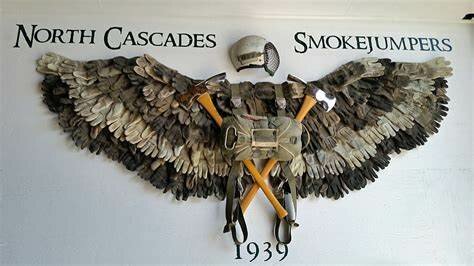
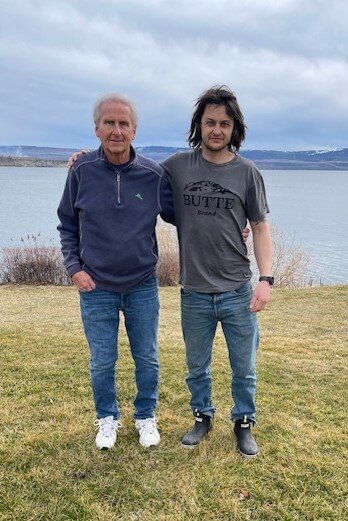


BREWSTER – Most milestones separated by half a century involve something significant to jump about. In the case of Rich and Chase Burgett it involves something to literally jump from.
The Burgett’s belong to an elite corps of past and present aerial firefighters – the smokejumpers – father, Rich (alum class of 1974) and son, Chase (active class of 2024). The two gathered recently to reflect on how some aspects of their shared experience – separated by 50 years - are similar while other aspects have changed. A good example involves how each landed his first fire job, one by circumstance, the other by design.
Rich, a 1970 Brewster High School graduate, was pumping gas in Pateros one week, and training to fight fires the next.
In 1971 Forest Service was hiring prospects off the street trying to put some trained crews together following what Rich termed “the hellacious fires” from the previous year.
“One of my friends told me they were hiring at Chelan, so I went there,” said Rich. “They picked 10 or 12 of us for a ground crew.”
Promotions came quickly after Rich’s initial hire.
In 1972 Rich joined a new helitack crew that had converted a Bell UH-1 (Huey) helicopter into a helitack transport.
“We would take off and land at the fire,” Rich explained of the quick insertion strategy.
“In 1973 we were the very first helitack crew converted to a rappelling crew,” said Rich. “You slide down a rope up to 250-feet long to the ground. We were trying to figure it out along the way.”
One of the instructors helping the rappellers learn the ropes was a jump foreman from the North Cascades Smokejumper Base (NCSB). At the end of the 1973 season the helitack crew members were offered the opportunity to apply for jumper positions the following year. Rich was one of two who took the offer to apply. He made his first jump in 1974 and stayed with the program for six seasons.
Fast forward a couple of decades and hiring procedures and qualifications have changed.
“Nowadays hiring is all done through a third party called USAJobs,” said Chase. “They look for people who have a couple years of experience through a Hotshot or Type 1 crew.”
Unlike his father, Chase set his sights on wildland firefighting following high school. After graduating Brewster in 2008 Chase hired on with the DNR in South Okanogan. He moved on to Entiat hand and Hotshot crews as he worked his way up the ladder to rappelling.
“Smokejumpers were my goal when I started out,” said Chase who made his first jump in 2024. “It took a while to get there. I was a permanent employee with the rappellers, but I’m giving that up to jump for another year.”
Parachute upgrades
Chase said one of the biggest changes during the half century from ’74 to ’24 is the type of parachutes jumpers now use. The round canopies of Rich’s era were replaced by the rectangular parafoil type models of the Ram-Air system adopted by the NCSB about four years ago.
“The Ram-Air is more technical, and the rigging, deployment, and flying are different,” said Rich. “Ours was a 15-foot static line attached to a deployment bag that pulled the parachute out.”
The new system gets the jumper more involved.
“We have a static line that opens a small drogue parachute,” said Chase. “All that does is stabilize us in every fall.”
During the fall under the jumper does a five-count, said Chase:
“During that time, you drop under drogue about 500 feet,” said Chase. “Then you pull a drogue release and the power generated by the drogue pulls out your main chute.”
“I’ve never flown a round chute,” said Chase. “Those who have used both systems say the Ram-Air is more maneuverable and durable with more forward drive to overcome moderate to high winds.”
Ground hazards
Contrary to what many might assume, the greater risk does not occur during the actual jump, but rather when jumpers are on the ground engaging a wildfire. What both Burgett’s call “gravity hazards” – falling trees, big boulders - pose the real danger for firefighters when their attentions are focused on the work of containment.
Rich related one near-miss while he was digging a fire line along one blaze.
“I was digging away with my head down when I heard a loud crack,” said Rich. “I looked up at a tree right in front of me that a two-foot-round boulder had rolled down and hit. Thank God the tree was there, or it would have taken me out.”
Despite the risks, both men value their smokejumper experiences, one in retrospect, the other returning.
Mike Maltais: 360-333-8483 or michael@ward.media


Comments
No comments on this item Please log in to comment by clicking here